Vietnamese exile opposition groups stage leaflet campaign
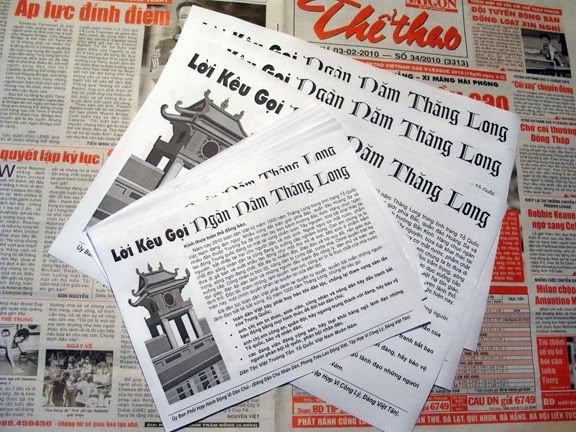
Democracy leaflets 'distributed in Vietnam' (AFP 15-2-10)
LỜI KÊU GỌI NGÀN NĂM THĂNG LONG
Kính thưa toàn thể đồng bào,
Năm nay 2010 toàn dân Việt kỷ niệm 1000 năm Thăng Long trong tình trạng Tổ Quốc Việt Nam đang lâm nguy. Nhiều vùng đất biên giới phía Bắc, quần đảo Hoàng Sa và nhiều đảo thuộc Trường Sa đã rơi vào tay bọn bành trướng Bắc Kinh. Hàng chục ngàn lao động Trung quốc đang có mặt tại vùng chiến lược Tây nguyên, bừa bãi khai thác tài nguyên, bất chấp tai hại cho người dân và môi sinh. Ngoài nguy cơ mất nước, phẩm chất đời sống nhân dân ta cũng đang bị xuống cấp nghiêm trọng. Con em chúng ta bị đưa đi gả bán và xuất khẩu lao động như một thứ nô lệ mới. Môi sinh ô nhiễm trầm trọng, sông ngòi đang chết, đất đai bị nhiễm độc. Đạo đức xã hội suy đồi, nền giáo dục xuống cấp. Công nhân bị bóc lột, nông dân bị cướp đất, cướp nhà. Chính quyền triệt hạ tôn giáo, đàn áp dân lành và những người đấu tranh đòi công lý, dân chủ và toàn vẹn lãnh thổ. Độc tài, tham nhũng, lạm quyền, bạo lực, công an trị là thực chất của nhà nước hiện nay, một chính quyền phản lại quyền lợi của dân tộc.
Đã đến lúc toàn dân Việt phải giành lại quyền tự quyết, quyền bãi miễn những người lãnh đạo bất tài bất xứng. Kỷ niệm 1000 năm Thăng Long, chúng tôi kêu gọi
· toàn dân Việt hãy phát huy hào khí dân tộc, chống lại tham vọng xâm lấn của Trung Quốc;
· anh chị em trí thức, sinh viên, công nhân và nông dân hãy đấu tranh bất bạo động bằng mọi hình thức để đòi hỏi dân chủ;
· anh chị em công an, quân đội, hãy ngưng trung thành với đảng, hãy bảo vệ Tổ quốc, bảo vệ nhân dân;
· các đảng viên đảng cộng sản, hãy loại khỏi hàng ngũ lãnh đạo những người phản bội tổ quốc, phản bội nhân dân.
Dân Tộc Việt Truờng Tồn. Tổ Quốc Việt Nam Muôn Năm.
Ủy Ban Phối Hợp Hành Động Vì Dân Chủ(Đảng Dân Chủ Nhân Dân, Phong Trào Lao Động Việt, Tập Hợp Vì Công Lý, Đảng Việt Tân)
Đính kèm là truyền đơn và những hình ảnh vể chiến dịch rải truyển đơn vừa qua.
Nguồn: http://danchutudochovietnam.blogspot.com/
Bộ trưởng Tài chính: 'Năm 2010 còn nhiều việc phải làm' (VnEx 15-2-10)
Minh triết là "trí tuệ được nhào nặn bởi kinh nghiệm"
Tiểu luận về "hai nền triết lý Đông - Tây" của Kim Định nêu nhiều vấn đề đến nay vẫn còn nguyên tính thời sự.
Những nguy hiểm khi tiêm Vitamin B12 giảm cân
(Dân trí) - Để giảm cân và kiểm soát trọng lượng cơ thể, nhiều người đã tìm cách thực hiện tiêm Vitamin B12. Tuy nhiên, ngoài tác dụng làm giảm trọng lượng gián tiếp, việc tiêm Vitamin B12 phải cẩn trọng vì chúng có nhiều tác dụng phụ nguy hiểm.
Vitamin B12 là một thành phần quan trọng cần cho cơ thể để thực hiện các nhiệm vụ khác nhau. Đây là Vitamin có trách nhiệm xây dựng DNA cũng như việc sản xuất huyết cầu. Do là một nguồn chính của chất dinh dưỡng cần thiết cho hoạt động lành mạnh của cơ thể nên nhiều người gọi nó là “vitamin năng lượng”.
Các nguồn chính của vitamin B12 là thịt, gia cầm, sữa, trứng và cá. Vitamin B12 tiêm trực tiếp tiêm vào cơ bắp sẽ khiến cơ thể dễ hấp thu tốt hơn các chất dinh dưỡng. Nhiều người lựa chọn tiêm vitamin B12 như một biện pháp khắc phục mệt mỏi ngay lập tức, vì nó làm tăng tốc độ của sự trao đổi chất. Đặc biệt, tiêm Vitamin B12 cũng rất hữu ích trong việc giảm cân.
The danger behind China's 'me first' worldviewMonday, February 15, 2010
It's become apparent from recent events that America's political, business and scholarly elites have fundamentally misjudged China. Conflicts with China have multiplied. Consider: the undervalued renminbi and its effect on trade; the breakdown of global warming negotiations in Copenhagen; China's weak support of efforts to prevent Iran from acquiring nuclear weapons; its similarly poor record in pushing North Korea to relinquish its tiny atomic arsenal; the sale of U.S. weapons to Taiwan; and Google's threat to leave China rather than condone continued censorship.
The United States and China view the world in starkly different terms. The lesson of the Great Depression and World War II for Americans was that isolationism was self-defeating. Tried after World War I, it failed. The United States had to engage abroad to protect its economy and physical security. These core ideas remain the bedrock justifications for overseas military commitments and the promotion of an open world economy. The quest is for stability, not empire.
China, too, covets stability. But its history and perspective are different, as Martin Jacques shows in his masterful "When China Rules the World." Starting with the first Opium War (1839-42) -- when England insisted on importing opium from India -- China suffered a string of military defeats and humiliating treaties that gave England, France and other nations trading and political privileges. In the 20th century, China was balkanized by civil war and Japanese invasion. Not until the communists' 1949 triumph in the civil war was there again a unified national government. These experiences left legacies: fear of disorder and memory of foreign exploitation.
Since 1978, China's economy has increased roughly tenfold. The prevailing American assumption was that as China became richer, its interests and values would converge with those of the United States. China would depend increasingly on a thriving global economy. Freer domestic markets would loosen the stranglehold of the Communist Party. The United States and China would not always agree, but disputes would be manageable.
It isn't turning out that way. A wealthier China has become more assertive, notes Jacques. American prestige has further suffered from the financial crisis originating in the United States. But the fissure goes deeper: China does not accept the legitimacy and desirability of the post-World War II global order, which involves collective responsibility among great powers (led by the United States) for world economic stability and peace.
China's policies reflect a different notion: China First.
Unlike the isolationist America First movement of the 1930s, China First does not mean global disengagement. It does mean engagement on China's terms. China accepts and supports the existing order when that serves its needs, as when it joined the World Trade Organization in 2001. Otherwise, it plays by its own rules and norms.
Trade policy is explicitly discriminatory to address two crucial problems: surplus labor and scarce commodities. The undervalued renminbi aims to help create 20 million or more jobs that Jacques cites as needed annually. China is scouring the globe to make investments in secure raw materials, particularly fuel. The object of "economic reform," Jacques writes, was "never Westernization" but "a desire to restore the [Communist] Party's legitimacy."
Most American-Chinese disputes reflect China's unwillingness to endanger domestic goals for international ends. It won't commit to binding greenhouse gas cuts because these could reduce economic growth and (again) jobs. On Iran, it values its oil investments more than it fears Iranian nukes. Likewise, it worries that unrest in North Korea could send refugees spilling across the border. Because Taiwan is regarded as part of China, U.S. arms sales there become domestic interference. And censorship is needed to maintain one-party control.
China's worldview threatens America's geopolitical and economic interests. Just recently, 19 U.S. trade associations wrote the Obama administration warning that new Chinese rules for "indigenous innovation" could "exclude a wide array of U.S. firms" from the Chinese market -- or force them to turn over advanced technology. (British firms are so incensed by "overwhelming protectionism" that some may quit China, reports the Telegraph newspaper.)
It would be a tragedy if these two superpowers began regarding each other as adversaries. But that's the drift. Heirs to a 2,000-year cultural tradition -- and citizens of the world's largest country -- the Chinese have an innate sense of superiority, Jacques writes. Americans, too, have a sense of superiority, thinking that our values -- the belief in freedom, individualism and democracy -- reflect universal aspirations.
Greater conflicts and a collision of national egos seem inevitable. No longer should we sit passively while China's trade and currency policies jeopardize jobs here and elsewhere. Political differences between the countries are increasingly hard to ignore. But given China's growing power -- and the world economy's fragile state -- a showdown may do no one any good. Miscalculation is leading us down dark alleys.
When politics sound the alarm on national security
China, too, covets stability. But its history and perspective are different, as Martin Jacques shows in his masterful "When China Rules the World." Starting with the first Opium War (1839-42) -- when England insisted on importing opium from India -- China suffered a string of military defeats and humiliating treaties that gave England, France and other nations trading and political privileges. In the 20th century, China was balkanized by civil war and Japanese invasion. Not until the communists' 1949 triumph in the civil war was there again a unified national government. These experiences left legacies: fear of disorder and memory of foreign exploitation.
Since 1978, China's economy has increased roughly tenfold. The prevailing American assumption was that as China became richer, its interests and values would converge with those of the United States. China would depend increasingly on a thriving global economy. Freer domestic markets would loosen the stranglehold of the Communist Party. The United States and China would not always agree, but disputes would be manageable.
It isn't turning out that way. A wealthier China has become more assertive, notes Jacques. American prestige has further suffered from the financial crisis originating in the United States. But the fissure goes deeper: China does not accept the legitimacy and desirability of the post-World War II global order, which involves collective responsibility among great powers (led by the United States) for world economic stability and peace.
China's policies reflect a different notion: China First.
Unlike the isolationist America First movement of the 1930s, China First does not mean global disengagement. It does mean engagement on China's terms. China accepts and supports the existing order when that serves its needs, as when it joined the World Trade Organization in 2001. Otherwise, it plays by its own rules and norms.
Trade policy is explicitly discriminatory to address two crucial problems: surplus labor and scarce commodities. The undervalued renminbi aims to help create 20 million or more jobs that Jacques cites as needed annually. China is scouring the globe to make investments in secure raw materials, particularly fuel. The object of "economic reform," Jacques writes, was "never Westernization" but "a desire to restore the [Communist] Party's legitimacy."
Most American-Chinese disputes reflect China's unwillingness to endanger domestic goals for international ends. It won't commit to binding greenhouse gas cuts because these could reduce economic growth and (again) jobs. On Iran, it values its oil investments more than it fears Iranian nukes. Likewise, it worries that unrest in North Korea could send refugees spilling across the border. Because Taiwan is regarded as part of China, U.S. arms sales there become domestic interference. And censorship is needed to maintain one-party control.
China's worldview threatens America's geopolitical and economic interests. Just recently, 19 U.S. trade associations wrote the Obama administration warning that new Chinese rules for "indigenous innovation" could "exclude a wide array of U.S. firms" from the Chinese market -- or force them to turn over advanced technology. (British firms are so incensed by "overwhelming protectionism" that some may quit China, reports the Telegraph newspaper.)
It would be a tragedy if these two superpowers began regarding each other as adversaries. But that's the drift. Heirs to a 2,000-year cultural tradition -- and citizens of the world's largest country -- the Chinese have an innate sense of superiority, Jacques writes. Americans, too, have a sense of superiority, thinking that our values -- the belief in freedom, individualism and democracy -- reflect universal aspirations.
Greater conflicts and a collision of national egos seem inevitable. No longer should we sit passively while China's trade and currency policies jeopardize jobs here and elsewhere. Political differences between the countries are increasingly hard to ignore. But given China's growing power -- and the world economy's fragile state -- a showdown may do no one any good. Miscalculation is leading us down dark alleys.
When politics sound the alarm on national security
Is scoring points on national security a problem?
Nhật Bản vẫn được xếp hạng thứ hai về kinh tế trên toàn thế giới trong năm 2009, trên cả Trung Quốc

